Why Starglass shows its work.
A model can sound right and be wrong. Sounding right is exactly the failure we couldn't afford.

Get cited answers in your browser, or connect Starglass to your AI app to search official records. Built for analysts, newsrooms and trade associations.
Citation receiptArchived 2 Oct 2026
18810182082026-10-02 04:41 UTCnppes:A registry listing is not proof of a license.
Redrawn from screenshots of our own session on 2 Oct 2026. Not recorded live.
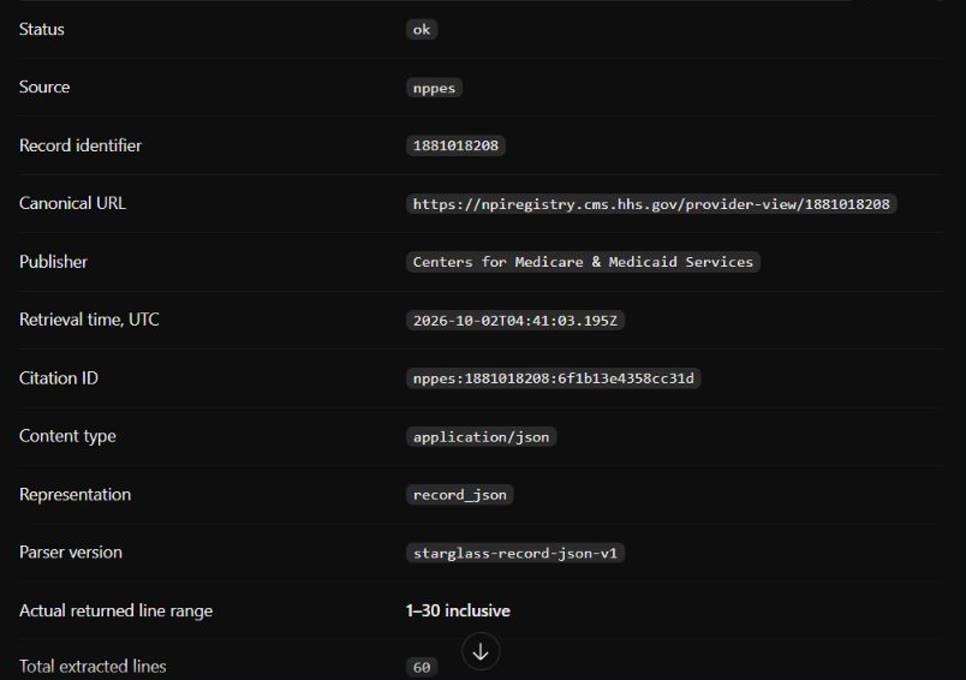
We asked Starglass for one public record from inside an AI app. This is what came back.
source_search source nppes, limit 1[source=nppes; record_id=1881018208] MAYO CLINICsource_fetch nppes:1881018208, lines 1–30Read-only tools offered in this session: sources_list, source_search, source_fetch.
Archived 2 Oct 2026
| Field | As returned | What it tells you |
|---|---|---|
| Publisher | Centers for Medicare & Medicaid Services | Who published the record. |
| Record | 1881018208 | Which record Starglass read. |
| Source | npiregistry.cms.hhs.gov/Open the record (opens in a new tab) | Where to check it yourself. |
| Retrieved | 2026-10-02 04:41 UTC | When Starglass read it. |
| Lines | 1–30 of 60 | How much came back. |
| Citation ID | nppes: | The reference your answer cites. |
| Note | A registry listing is not proof of a license. | What this record can't show. |
Your AI app writes the answer. Starglass returns the record and its receipt.
A model can sound right and be wrong. Sounding right is exactly the failure we couldn't afford.
Start in your browser, or connect the AI app you already use.
No card required.
Installing a plugin doesn't create an account or start your trial. Your AI app's subscription is separate.
Ask your question in Quick Answer. Sign-in required.
Open the Starglass appInstall the plugin. Run these in your terminal:
claude plugin marketplace add Jeremyaculeus/Sign in, then start a new session:
claude mcp login plugin:Add the server:
codex mcp add starglass --url https://aculeus.ai/api/mcpSign in:
codex mcp login starglass --oauth-client-registration cimd --scopes profile,Add the research workflow:
npx skills add Jeremyaculeus/The skill guides the research workflow. It doesn't connect the server or grant access.
Codex setupYou need permission to create custom apps. Availability depends on your plan and workspace settings.
Create a custom app, name it Starglass, paste this server URL and choose OAuth:
https://aculeus.ai/api/mcpWe tested on a personal Pro account, which doesn't guarantee yours. It's a custom connection, not a directory listing.
ChatGPT setupUse Starglass to list its sources and limits. Then search NPPES for Mayo Clinic organizations with one result, and fetch that record's lines 1 to 30 with its citation receipt.You should see a source link and a receipt.
The Starglass tools search USAspending, SEC filings, FEC committee registrations, Congress, GovInfo, Senate lobbying disclosures and the NPPES provider registry. Starglass checks availability each session.
Ask a focused question in your browser. Every sentence in the answer must cite a source, or Quick Answer won't send it. Checking that the source says what the line claims is still your call.
Connect it over MCP, the open standard AI apps use to connect to outside tools. Your AI app can then list sources, search official records, fetch cited passages and check evidence. The tools are read-only.
It records what Starglass read: which record, from which publisher, when, and how much came back. It doesn't certify that the source's claims are true. Receipts come with each passage the Starglass tools fetch in your AI app. Quick Answer in your browser gives source links instead.
When you use Starglass in your AI app, we keep your account, your connected apps and a count of your requests. We don't store your searches or the returned text in a Starglass workspace. Quick Answer keeps your requests, its answers and our providers' cost records. We use them to run the service, reconcile costs and support you. The Privacy Notice has the details.
This claim comes from a Deep Research Case. The saved source is open at the words it cites.
U.S. nonfarm business labor productivity rose 2.1% in 2025, after 3.0% in 2024. [18]
An example Case, not a customer's.
Source [18]
Productivity and Costs — 2025 annual averages
Labor productivity growth and related measures – annual average changes: 2021-2025 Labor Hours Hourly Real hourly Unit labor Sector Year productivity Output worked compensation compensation costs Nonfarm business 2025 2.1 2.5 0.4 4.5 1.8 2.3 2024 3.0 2.9 0.0 5.5 2.5 2.4 2023 2.0 3.1 1.1 4.0 -0.1 2.0 2022 -1.5 2.5 4.0 3.6 -4.2 5.2 2021 2.1 7.6 5.4 5.0 0.2 2.9 Manufacturing 2025 1.9 1.0 -0.9 4.4 1.7 2.4 2024 0.3 -0.9 -1.2 5.0 2.0 4.7 2023 -0.4 -0.4 0.0 4.1 0.0 4.5 2022 -2.1 1.9 4.1 2.7 -5.0 4.9 2021 1.7 5.0 3.2 2.3 -2.4 0.6 TECHNICAL NOTES Labor Hours Hours worked data for the labor productivity and cost measures include hours worked for all persons working in the sector—wage and salary workers, the self-employed and unpaid family workers. The primary source of hours and employment data is the BLS Current Employment Statistics (CES) program, which provides monthly survey data on the number of jobs held by and hours paid to wage and salary workers in nonfarm establishments, counting a person who is employed by two or more establishments at each place of employment. As of the February 3, 2023 Employment Situation release, the CES program has updated the national nonfarm payroll series to the 2022 North American Industry Classification System (NAICS). The BLS Major Sector Productivity program will be remaining on a NAICS 2017 basis for the time being by converting NAICS 2022 data from CES back to a NAICS 2017 basis using ratios published on the CES website and based on the Quarterly Census of Employment and Wages (QCEW). Hours of paid time off are removed from hours paid using data from the National Compensation Survey (NCS) for 1996 forward and data from the BLS Hours at Work survey, conducted for this purpose, prior to 1990. Between 1990 and 1995, hours of paid time off are removed using a combination of NCS and Hours at Work survey data. Off-the-clock hours are added, yielding hours worked, using data from the Current Population Survey (CPS). Data from the CPS are used to estimate hours worked for farm labor, nonfarm proprietors, and nonfarm unpaid family workers. Using CPS information on employment and hours worked at primary jobs and all other jobs, separately, the BLS productivity measures assign all hours worked to the appropriate industrial sector. Hours for government enterprises are derived from the CPS, the CES, and the National Income and Product Accounts (NIPA) prepared by the Bureau of Economic Analysis (BEA) of the Department of Commerce.
This saved copy holds the opening part of a longer source.
Read the marked row: Nonfarm business, 2025. Labor productivity 2.1, output 2.5, hours worked 0.4, hourly compensation 4.5, real hourly compensation 1.8, unit labor costs 2.3. 2024: labor productivity 3.0.
Annual average changes. Column names come from the same table.
Deep Research runs in managed Starglass workspaces. We set it up with you. It isn't in the trial or the monthly plan.
Ask about Deep ResearchSee the whole Case (opens in a new tab)
Free for 30 days, then $49 per seat per month. No card required.
